
Mountain Bike Shoes: It's Not a One-Size-Fits-All Situation
One of the most important components for safe and enjoyable mountain biking is the pedal.
There are many types of pedals, but flat pedals are recommended for mountain bikes. They have a large surface area for solid footing, and the included pins firmly grip your shoes, preventing slips. You can ride with confidence, knowing your feet won't easily come off even on rough terrain.
Mastering flat pedals is essential and the fastest way to improve your MTB skills.
However, many people have good pedals but wear unsuitable shoes.
They might be wearing running shoes or boots...
In fact, the shoes you use for MTB are just as important as the pedals, not just any footwear will do.
So, this time, we're talking about shoes, not pedals.

There are certain conditions that shoes for mountain biking should meet.
These are:
1. Flat, grippy sole
2. Stiff midsole
3. Toe cap
These three conditions are the minimum requirements for MTB shoes.
Conversely, as long as these three conditions are met, any shoe will do.
Let me explain in a little more detail.
1. Flat, grippy sole
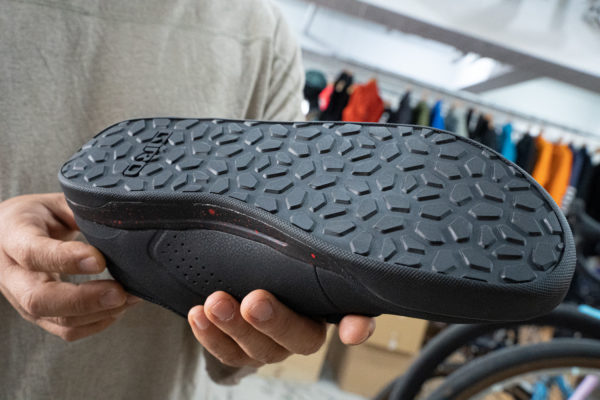
A flat sole allows your entire foot to make firm contact with the flat pedal, providing stability and control over the bike. A sole that grips well regardless of the weather increases confidence. You can't rely on shoes that might slip at a critical moment.
2. Stiff midsole
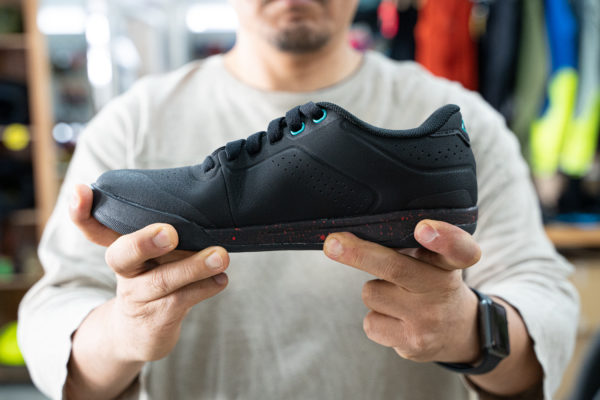
A stiff midsole prevents the sole from deforming excessively, even when you apply weight or experience impacts from the ground. This allows you to maintain sufficient grip even if your foot isn't perfectly positioned or slips slightly. It reduces distractions from not being in the optimal pedaling position and also mitigates impacts from the ground. However, a midsole that is too stiff, like on clipless shoes, is not ideal.
3. Toe cap
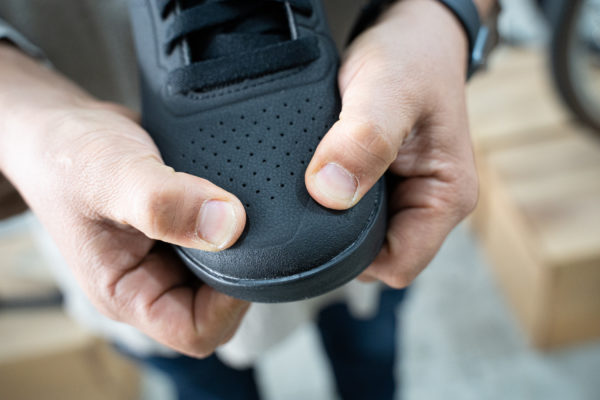
Mountain bike trails are not always smooth. Rocks, roots, and tree stumps often protrude from the ground. A toe cap protects your toes from these obstacles. Hitting your toe on a rock or stump without a toe cap can be extremely painful...
Are VANS not good enough?
This is a common question.
VANS are also a classic choice for mountain biking shoes.

The answer is:
Not bad, but not the best.
MTB-specific shoes are more comfortable and provide more security.
Let me also introduce the characteristics of VANS.
Their most distinctive feature is the thin and very soft waffle sole.
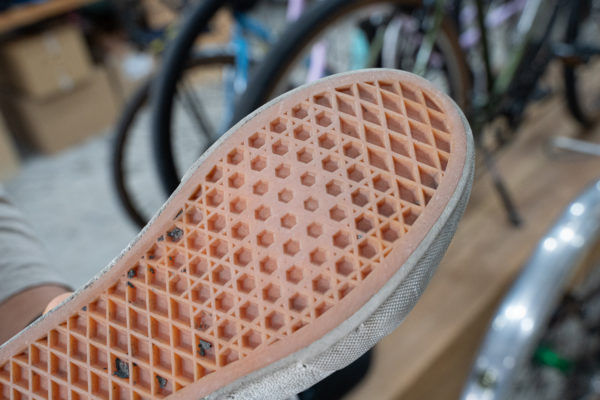
It's flexible enough that you can grip the pedal with your toes, and it offers excellent grip.
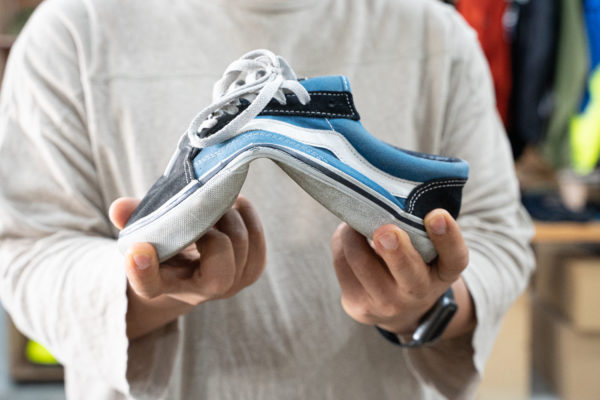
Its flexibility allows for better feel of the terrain and bike behavior, making it easier to fine-tune weight shifts for techniques like push-pull.
Many people who prefer VANS likely do so because of this waffle sole.
For disciplines like dirt jumping and pump tracks, where sensitive feedback from the pedals is crucial, VANS often perform better.
On the other hand, this softness can also be a disadvantage. When there's a big impact, the shock can be too direct, causing pain in the soles of your feet. Also, if you miss the optimal foot position, stability can quickly be compromised.
In downhill and trail riding, where there are constant, varying impacts and frequent foot adjustments, the disadvantages often outweigh the benefits.
It's about choosing the right tool for the job.
In fact, I used to prefer VANS, but one day when I tried MTB-specific shoes, I felt advantages that VANS didn't offer, and I couldn't go back. Those were the "stiff midsole" and "toe cap" from the three conditions I mentioned earlier. Since then, I've been using MTB-specific shoes.
This is also why VANS are not bad, but not the best. They offer good grip, but they don't provide the same level of security.
Beyond that, there's a matter of style preference. If you like the style of VANS, including their drawbacks, then that's fine. I think it looks cool.
Returning to the main topic, in addition to the three minimum requirements, many MTB-specific shoes also feature tongue (or "velo") constructions that prevent sand and mud from entering the shoe, and finishes or manufacturing methods that resist water penetration.
Other factors, such as shoe weight and sole thickness, vary depending on the manufacturer and model.
Recently, many manufacturers have been producing MTB-specific shoes. Regardless of the brand or model, the basic requirements are usually met, so you'll likely be satisfied with any choice you make. However, among the various shoes I've personally worn, I'd like to introduce some that I've found to be particularly effective.
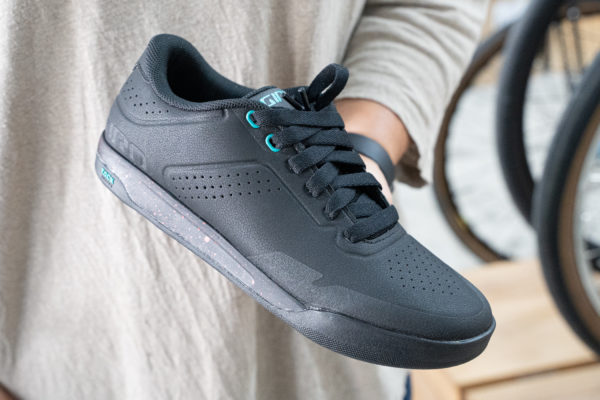
Its lightness and thin sole are particularly noteworthy.
Weighing 327g for size 42, there are no other MTB shoes this light.
The sole is about 5mm thinner than typical MTB shoes, bringing your foot closer to the pedal for exceptional control. The grip is just right, not too strong.
And most importantly, they're easy to walk in. Even if you frequently dismount and walk, their lightness helps prevent fatigue.
I felt this was the only choice for trail riding.
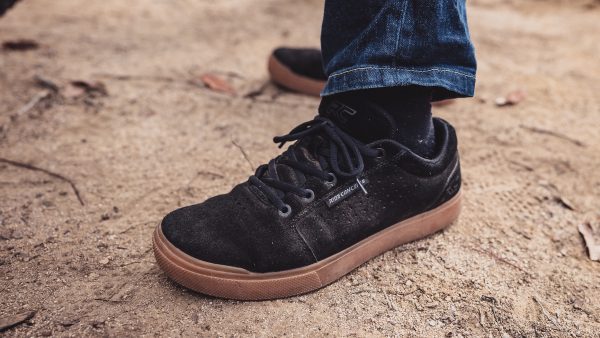
At first glance, it looks like a low-tech sneaker, but inside, it's a cutting-edge, serious MTB shoe.
With just the right amount of grip, it's perfectly compatible with flat pedals. It's an all-around performer, suitable for everything from dirt jumping to downhill.
It looks completely natural with jeans, making it especially recommended for those with a casual style.
MID-cut models are also available, so you can choose the style you prefer.
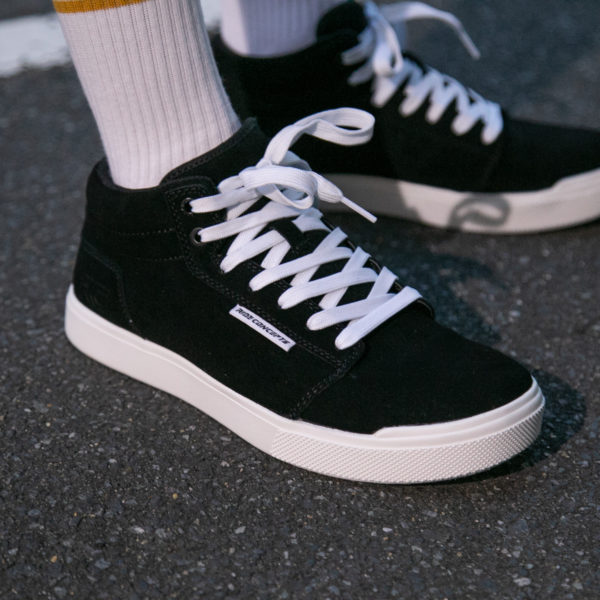
If you just want a dedicated pair of shoes, this is the one.
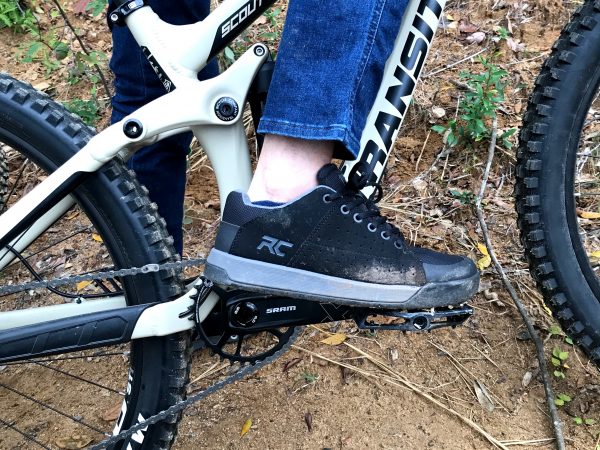
Even though I say "just", it meets all the desired conditions and I have no complaints whatsoever.
Everything is above average. It's a model you can't go wrong with.
Consider MTB pedals and shoes as a set.
Even if only one of your pedals or shoes is good, the benefits are halved. Both good shoes and good pedals are needed to maximize their effectiveness.
Here are some pedals that are well-suited for MTB shoes:
You can't go wrong with any of these pedals.